Minister of Immigration and incumbent conservative candidate for parliament in the Ajax-Pickering circunscription, Chris Alexander, was recorded saying during a fundraising event that the Canadian immigration system is probably one of the fastest in the world.
This was in response to the inquiries of a Canadian who is currently sponsoring her spouse to become a Permanent Resident and is facing the delays of 26 months in the process. These delays are unique to Canada, since most developed countries process this kind of application in 6 months or less.
Check out more about these words from Chris Alexander and the current facts in this video:
--
Follow our progress on Twitter and Facebook
Sign up to our newsletter
--
Might also interest you:
Is Family Reunification subsidizing Temporary Foreign Worker applications?
The truth about marriage fraud in family sponsorship applications
Inland Spousal Sponsorship: One of the categories that fell further behind

We are the team behind the documentary The Backlog, about the delays in Canadian Immigration. Follow the progress of our project and become part of it with your suggestions, comments and even testimonials. Contact us at thebacklogdoc(at)gmail(dot)com
Showing posts with label government. Show all posts
Showing posts with label government. Show all posts
2015/08/05

2015/06/24
Is Family Reunification subsidizing Temporary Foreign Worker applications?
We have discussed in previous blog posts how the Spousal Sponsorship category has fallen behind in the last two years of management at Citizenship and Immigration Canada. Minister Chris Alexander claims that the reason for these delays is the increase in marriage fraud and the time and resources it takes to detect it.
However, CIC's 2014–2015 Report on Plans and Priorities (1) points to another direction: Spousal sponsorship applications are generating revenue, while Temporary foreign worker ones are actually causing losses.
Here are some facts shown by this report:
When taking the amount spent per year in processing applications to sponsor a spouse, common law partner or dependant children, the minimum and maximum goals of applications processed and the fees paid by the applicants, the results are actually profits.
In the 2014-15 year, CIC's budget for this stream (including inland and outland applicants) was $27.472.071. The goal was to process between 45,000 and 48,000 applications, which means an expense that goes between $572,33 and $610,49 per application (see the numbers).

But applicants are in fact charged with $1,100, according to the CIC website, which means an amount between $489,51 and $527,67 that is charged to these applicants but not invested in processing their applications.
From the 9 Permanent Residency streams shown in the report (except for refugee claimants), 8 streams presented the same situation: the amount of fees charged was considerably superior to the amount of resources invested in their applications.
The leftover category, Federal Skilled Workers, presents a deficit of over 30 million dollars which, according to CIC, responds to return of fees made to applicants whose applications were returned without being processed.
In 2012, CIC returned 300,000 Federal Skilled Worker applications (2) submitted prior to February of 2008 and still not processed in order to reduce backlogs. CIC said they would return the processing fees for all these applications, which costs the Government nearly 150 million dollars.
Where are all these fees going? Here's an idea...
The Report on Plans and Priorities specifies the amount assigned per year to each immigration stream and the minimum and maximum goals for processed applications that year.
For example, for TFWs, the amount assigned for the 2014-15 year is $23,488,233, and the processing goals are between 15,000 and 30,000 applications. This means that processing each application will cost between $782.94 and $1,565.88.

However, applicants requesting a TFW permit pay only $155, which only covers 10 to 20% of the real cost of processing their application. The remaining 80 to 90% of the cost for processing TFW applications goes from nearly 19 to 21 million dollars (tweet this), which are subsidized by CIC.
Of course, since refugee claimants don't pay fees, people might think profits from Family Reunification and other PR categories are going to fund these applications, and this is in part true. However...
Total expenses for refugee applications and related services go between 44 and 45 million dollars in the 2014-15 period, according to the mentioned report. However, the profits made over 8 out of 9 permanent residency streams go between 80 and 92 million dollars.
While subsidies to the TFW program oscillate between 19 and 21 million dollars, this is not the only temporary stream to be subsidized. So is the International Student program.
Processing fees for International Students are currently $150. Student permits now allow students to work in Canada, inside or outside campus, without any extra requirements. The amount invested by CIC to process these applications and grant these permits goes between $782,94 and $1565,88, between 80 and 90% more of what's charged to applicants.
The deficit to process these applications in the 2014-15 period is around 10 million dollars.
Although we can't establish a link between the profits generated by Family Reunification and the losses for the Temporary Foreign Worker applications since CIC has consistently declined all our interview requests or follow up to our still unanswered questions.
Despite the lack of replies, there's a clear problem: family reunification has experienced an increase in processing times and a higher error rate, while fees have been increased, and half of the fees these families are paying are not being invested in their stream. This while they are told CIC has no resources to improve their stream.
In the meantime, applications for a Temporary Work Permit have considerably faster processing times, between 1 to 13 months depending on the visa office that processes it. Average processing times in the 50 Canadian visa offices abroad processing work permits is 3 months.
The impact of cutting existing resources from one stream and increasing them for other is clearly visible in terms of processing times. However, if Canadian families are in fact paying much more than what's invested in their application, they deserve to know why this is happening and where are their fees going.
And there are still more discouraging facts in this report...
This report shows the amount to be spent and staff assigned to process applications for each stream in the next three years. All permanent residency and refugee categories see a decrease in staff and budget for the next three years, while it's expected that the fees remain the same or, worst case scenario, increase. Application goals are kept the same, which means less money will be invested to process each application, while the same or more fees will be charged to applicants, generating more profits.
The only two categories that see an increase in both staff and budget, while the goals are also the same, are Temporary Foreign Workers and International Students, which means more money will be invested per application.
Family sponsorship is one of the few immigration categories that involves Canadian citizen and permanent residents. Canadians sponsoring their spouses to become permanent residents are charged $1,100 to process these applications.
They have seen processing times for their stream increase from 14 months in 2013 to 25 months in 2015.
They have been told it was due to marriage fraud investigations, but they (and we) learned through CIC's own eCas system that applications remain untouched for 15 months and are then processed in between 2 and 3 weeks. We also learned through expert Klaudios Mustakas that CIC is not mandated to further investigate into a marriage.
They have been told this delay is due to lack of resources, but now this report shows us that half of the fees they are paying to get their applications processed are not being invested in their stream (tweet this) and that, in the meantime, 80% of the costs associated with processing temporary foreign worker permits are being subsidized by CIC.
Now, CIC's new policy doesn't allow Spousal Sponsorship applicants to check the status of their files via call centre until 15 months have passed (tweet this), which means they can't check if documents they sent have been received or if there has been any problem with their file.
We have received reports of documents and entire applications going missing after submitted to CIC (tweet this). It has been documented in the press. The most recent audit made at CPC Vegreville, where Inland Spousal Sponsorship applications were processed until February, 2014, showed a 2/3 error rate (3).
Despite all these facts, Canadians are told they have to wait 25 months. They don't know why the long wait. They don't know why their fees are being invested somewhere else when there are obvious problems in their streams. They don't know why, despite CIC's high error rate and problems with their online monitoring system, they are not allowed to check the status of their applications on the phone.
Please help us find the answers and give this issue the awareness it deserves.
--
Follow our progress on Twitter and Facebook
Sign up to our newsletter
--
Sources:
However, CIC's 2014–2015 Report on Plans and Priorities (1) points to another direction: Spousal sponsorship applications are generating revenue, while Temporary foreign worker ones are actually causing losses.
Here are some facts shown by this report:
1. Sponsorship applications (and most PR applications) generate significant revenue
When taking the amount spent per year in processing applications to sponsor a spouse, common law partner or dependant children, the minimum and maximum goals of applications processed and the fees paid by the applicants, the results are actually profits.
In the 2014-15 year, CIC's budget for this stream (including inland and outland applicants) was $27.472.071. The goal was to process between 45,000 and 48,000 applications, which means an expense that goes between $572,33 and $610,49 per application (see the numbers).

But applicants are in fact charged with $1,100, according to the CIC website, which means an amount between $489,51 and $527,67 that is charged to these applicants but not invested in processing their applications.
From the 9 Permanent Residency streams shown in the report (except for refugee claimants), 8 streams presented the same situation: the amount of fees charged was considerably superior to the amount of resources invested in their applications.
The leftover category, Federal Skilled Workers, presents a deficit of over 30 million dollars which, according to CIC, responds to return of fees made to applicants whose applications were returned without being processed.
In 2012, CIC returned 300,000 Federal Skilled Worker applications (2) submitted prior to February of 2008 and still not processed in order to reduce backlogs. CIC said they would return the processing fees for all these applications, which costs the Government nearly 150 million dollars.
Where are all these fees going? Here's an idea...
2. Temporary foreign worker applications are heavily subsidized
The Report on Plans and Priorities specifies the amount assigned per year to each immigration stream and the minimum and maximum goals for processed applications that year.
For example, for TFWs, the amount assigned for the 2014-15 year is $23,488,233, and the processing goals are between 15,000 and 30,000 applications. This means that processing each application will cost between $782.94 and $1,565.88.

However, applicants requesting a TFW permit pay only $155, which only covers 10 to 20% of the real cost of processing their application. The remaining 80 to 90% of the cost for processing TFW applications goes from nearly 19 to 21 million dollars (tweet this), which are subsidized by CIC.
Of course, since refugee claimants don't pay fees, people might think profits from Family Reunification and other PR categories are going to fund these applications, and this is in part true. However...
3. Only half of the profits from other applications are invested in refugee claims
Total expenses for refugee applications and related services go between 44 and 45 million dollars in the 2014-15 period, according to the mentioned report. However, the profits made over 8 out of 9 permanent residency streams go between 80 and 92 million dollars.
While subsidies to the TFW program oscillate between 19 and 21 million dollars, this is not the only temporary stream to be subsidized. So is the International Student program.
Processing fees for International Students are currently $150. Student permits now allow students to work in Canada, inside or outside campus, without any extra requirements. The amount invested by CIC to process these applications and grant these permits goes between $782,94 and $1565,88, between 80 and 90% more of what's charged to applicants.
The deficit to process these applications in the 2014-15 period is around 10 million dollars.
Although we can't establish a link between the profits generated by Family Reunification and the losses for the Temporary Foreign Worker applications since CIC has consistently declined all our interview requests or follow up to our still unanswered questions.
Despite the lack of replies, there's a clear problem: family reunification has experienced an increase in processing times and a higher error rate, while fees have been increased, and half of the fees these families are paying are not being invested in their stream. This while they are told CIC has no resources to improve their stream.
In the meantime, applications for a Temporary Work Permit have considerably faster processing times, between 1 to 13 months depending on the visa office that processes it. Average processing times in the 50 Canadian visa offices abroad processing work permits is 3 months.
The impact of cutting existing resources from one stream and increasing them for other is clearly visible in terms of processing times. However, if Canadian families are in fact paying much more than what's invested in their application, they deserve to know why this is happening and where are their fees going.
And there are still more discouraging facts in this report...
4. Staff and resources decrease for all PR categories and increase for all temporary ones each year
This report shows the amount to be spent and staff assigned to process applications for each stream in the next three years. All permanent residency and refugee categories see a decrease in staff and budget for the next three years, while it's expected that the fees remain the same or, worst case scenario, increase. Application goals are kept the same, which means less money will be invested to process each application, while the same or more fees will be charged to applicants, generating more profits.
The only two categories that see an increase in both staff and budget, while the goals are also the same, are Temporary Foreign Workers and International Students, which means more money will be invested per application.
Conclusion
Family sponsorship is one of the few immigration categories that involves Canadian citizen and permanent residents. Canadians sponsoring their spouses to become permanent residents are charged $1,100 to process these applications.
They have seen processing times for their stream increase from 14 months in 2013 to 25 months in 2015.
They have been told it was due to marriage fraud investigations, but they (and we) learned through CIC's own eCas system that applications remain untouched for 15 months and are then processed in between 2 and 3 weeks. We also learned through expert Klaudios Mustakas that CIC is not mandated to further investigate into a marriage.
They have been told this delay is due to lack of resources, but now this report shows us that half of the fees they are paying to get their applications processed are not being invested in their stream (tweet this) and that, in the meantime, 80% of the costs associated with processing temporary foreign worker permits are being subsidized by CIC.
Now, CIC's new policy doesn't allow Spousal Sponsorship applicants to check the status of their files via call centre until 15 months have passed (tweet this), which means they can't check if documents they sent have been received or if there has been any problem with their file.
We have received reports of documents and entire applications going missing after submitted to CIC (tweet this). It has been documented in the press. The most recent audit made at CPC Vegreville, where Inland Spousal Sponsorship applications were processed until February, 2014, showed a 2/3 error rate (3).
Despite all these facts, Canadians are told they have to wait 25 months. They don't know why the long wait. They don't know why their fees are being invested somewhere else when there are obvious problems in their streams. They don't know why, despite CIC's high error rate and problems with their online monitoring system, they are not allowed to check the status of their applications on the phone.
Please help us find the answers and give this issue the awareness it deserves.
--
Follow our progress on Twitter and Facebook
Sign up to our newsletter
--
Sources:
1. Report on Plans and Priorities 2014-2015. Citizenship and Immigration Canada. Published: 2014. Retrieved: June 22, 2015.
2. 300,000 skilled worker applications are being eliminated. Canadian Immigrant. Published: March 29, 2012. Retrieved: June 23, 2015
3. ‘High error rate’ found in Canada’s immigration processing. The Toronto Star. Published: January 5, 2015. Retrieved: June 24, 2015
2015/06/05
Marriage fraud: CIC's justification for a two year delay

When the Minister of Immigration, Chris Alexander, was asked last May about delays in the Inland Spousal Sponsorship stream during a fundraising campaign of the Conservative Party, he justified the delay by talking about marriage fraud. He said investigation against marriage fraud was one of the big reasons to take more than two years to process applications of Canadians sponsoring their foreign spouses to become permanent residents.
The chief of staff of Citizenship and Immigration Canada, Chris Day, has also justified the long delays with the same allegation. What both of them have failed to mention is statistics on the percentage of Inland and Outland Spousal Sponsorship cases per year resulted into marriage fraud. More deeply, how many of the cases that were refused for alleged marriage fraud were also rejected in court appeals, and how many of these applicants were posteriorly prosecuted or deported.
Applicants don't even know the exact process CIC uses to assess the legitimacy of their marriages, or how many of the 26 months it currently takes to process an application is actually used to ensure this. None of the promotional pieces CIC has produced to alert about marriage fraud includes statistics about this problem. These numbers can't be found on the CIC website either.
This touching CIC video does not include a single piece of statistics about the incidence of marriage fraud
In a recent article by The Toronto Star (6), Minister Chris Alexander's spokeperson, Kevin Menard, said in response to testimonials published by the journal that “anecdotal accounts are not necessarily more broadly representative or, unfortunately, even factual in some cases”. Unfortunately, the previous video, produced and promoted by CIC, only shows "anecdotal accounts" and not statistics about marriage fraud in Canada.
This is what we know so far, thanks to press, CIC workers and applicants themselves:
1. Marriage fraud is not as frequent as CIC is selling it
According to an article by CBC (1), between 2008 and 2010, the Canada Border Services Agency received around 200 leads regarding cases of marriage fraud, and only prosecuted 39 applicants.
 |
| Image courtesy: Canada Inland Spousal Sponsorship Petitioners |
This article by the Toronto Star (2) goes deeper in cases from 2010: from the 46,300 spousal sponsorship applications, 7,400 (16%) were denied. 3,000 were appealed and 1,200 won the appeal in court. That gives a total of 6,200 applications (13%) that didn't go through.
2. CIC already has measures against marriage fraud that shouldn't impact processing times
Due to the findings previously quoted, CIC ammended the Immigration and Refugee Protection Regulations (3) starting October 25, 2012, to include a new rule: sponsored spouses who have been in a relationship of two years or less with their sponsors and have no children in common are subject to a conditional permanent residence status (4). They must cohabit in a legitimate relationship with their sponsor for two years from the moment they receive Permanent Resident status, or this could be revoked.
Additionally, when a sponsor signs the mandatory form Application to Sponsor, Sponsorship Agreement and Undertaking (5), they agree to "provide financial support for spouse or common‑law partner’s basic requirements, and those of his or her dependent children" for three years after the sponsored spouse receives Permanent Residency. Also, if the sponsored spouse ever collected social security assistance during that period, the sponsor must refund it in full.
For those applicants trying to fool the system, penalties are not light: fines of up to $100,000, prison for up to five years and risk of deportation are just some of them. Also, an immigrant who was sponsored by their spouse can't sponsor another spouse for five years after obtaining permanent residency, which limits cases of fraud.
3. CIC does not invest 26 months investigating an application, as they claim
Immigration expert Klaudios Mustakas, who worked at Citizenship and Immigration Canada for 37 years, declared that CIC is not mandated to do further investigation on marriages other than reviewing proof of cohabitation already requested in the initial package. Further investigation into a marriage falls into the jurisdiction of the Canadian Border Services Agency (CBSA)
Additionally, according to CICs own eCas system, the online tool that allows (some) Canadian sponsors and foreigns spouses to monitor the progress of their online applications, their files remain untouched by CIC officers for more than a year, and are actually processed in two to three weeks.
When consulting eCas, applicants find records like this one:
 |
| This application remained untouched for 16 months |
The applicants who shared this information received a decision about their application at the end of May, which means the real processing of their application, according to the information CIC provided to them, was two weeks. The rest of the 16 months was not used to research the legitimacy of their relationship, since they clearly say that they started processing their application in May 14, 2015.
We have received several screenshots like this one from other applicants, showing that their applications were not touched for nearly 16 months, then solved in two to three weeks.
4. The best solution against marriage fraud is quick processing of sponsorship applications
Imagine there is a fraudster among us. He or she managed to make a Canadian fall in love with them, or paid them to fake a marriage. With the current processing times of 26 months, this fraudster will remain in Canada, undetected, for at least 16 months, but more than two years could pass by without any authority noticing it.
If they run with enough luck, they might be among the 4 out of 5 applicants who do receive a work permit with the one-year pilot program CIC launched. They will be able to work in Canada for 16 to 26 months completely undetected, because CIC won't touch their file until then.
 |
| Image courtesy: Canada Inland Spousal Sponsorship Petitioners |
If applications were processed in less than 6 months, as it happens in most developed countries, fraudsters wouldn't go undetected for so long. They would be prosecuted and/or deported in no time, and others wouldn't feel encouraged to try this path.
 |
| Image courtesy: Canada Inland Spousal Sponsorship Petitioners |
While this fraudster is favored by the unprecedent delays in the Inland Spousal Sponsorship category, true couples are living a real nightmare.
For Canadians sponsoring their spouses, processing times of 26 months are an economic and emotional distress. We have already talked about this subject in a previous post, and will go deeper in our documentary.

Our research has shown that slow processing times in this category, instead of fighting marriage fraud, are working against genuine couples and in favor of fraudsters.
Is this what you want?
--
Follow our progress on Twitter and Facebook
Sign up to our newsletter
--
Sources:
1. Marriage fraud targeted by Canada Border Agency. CBC. Published: November 1, 2011. Retrieved: June 4, 2015
2. Marriage fraud: Canadian immigration officials tread thin line. The Toronto Star. Published: April 29, 2013. Retrieved: June 4, 2015
3. Backgrounder — Conditional Permanent Resident Status. Citizenship and Immigration Canada. Retrieved: June 4, 2015
4. Information for Sponsored Spouses or Partners. Citizenship and Immigration Canada. Retrieved: June 4, 2015
5. Application to Sponsor, Sponsorship Agreement and Undertaking. Citizenship and Immigration Canada. Retrieved: June 4, 2015
6. Has Canada's immigration system lost its heart? The Toronto Star. Published: May 31, 2015. Retrieved: June 5, 2015
Sources:
1. Marriage fraud targeted by Canada Border Agency. CBC. Published: November 1, 2011. Retrieved: June 4, 2015
2. Marriage fraud: Canadian immigration officials tread thin line. The Toronto Star. Published: April 29, 2013. Retrieved: June 4, 2015
3. Backgrounder — Conditional Permanent Resident Status. Citizenship and Immigration Canada. Retrieved: June 4, 2015
4. Information for Sponsored Spouses or Partners. Citizenship and Immigration Canada. Retrieved: June 4, 2015
5. Application to Sponsor, Sponsorship Agreement and Undertaking. Citizenship and Immigration Canada. Retrieved: June 4, 2015
6. Has Canada's immigration system lost its heart? The Toronto Star. Published: May 31, 2015. Retrieved: June 5, 2015
2015/05/14
Interviews in progress
First of all, we want to thank you for your support during our crowdfunding campaign on Indiegogo, either contributing or sharing on your social media channels to spread the voice.
We already started conducting the interviews we had planned. We interviewed an affected couple during the Ottawa protest in March and we just interviewed another couple from Ontario this week. We are also planning to interview another couple from Calgary at the end of the week, and immigration expert Klaudios Mustakas next week, among others.
Although we didn't raise our goal throughout the campaign, we adapted our budget to make this project a reality. That included, of course, recording some interviews remotely to save on traveling expenses. However, the results have been wonderful so far: the interviews have been very fluent, open and touching, showing the human side of this conflict.
If you're a couple affected by the Inland Sponsorship delays, you can still get in touch with us via email and share your story with us, either publicly for the documentary, or privately for research purposes.

We already started conducting the interviews we had planned. We interviewed an affected couple during the Ottawa protest in March and we just interviewed another couple from Ontario this week. We are also planning to interview another couple from Calgary at the end of the week, and immigration expert Klaudios Mustakas next week, among others.
Although we didn't raise our goal throughout the campaign, we adapted our budget to make this project a reality. That included, of course, recording some interviews remotely to save on traveling expenses. However, the results have been wonderful so far: the interviews have been very fluent, open and touching, showing the human side of this conflict.
If you're a couple affected by the Inland Sponsorship delays, you can still get in touch with us via email and share your story with us, either publicly for the documentary, or privately for research purposes.
2015/04/08
We need your support! Indiegogo campaign to fund the documentary
As of today, we have launched our Indiegogo campaign to fund the production of this documentary.
If you want to support us and get the struggle of more than 10 thousand Canadians out in the open, please click here and make your contribution today.
We are offering several perks including the documentary on Vimeo On Demand, exclusive content such as posters, full-length interviews and the screenplay, tickets for our exclusive screening and so much more.

Your contribution, small or big, will help bring this story to all Canada and beyond.
If you can't contribute to the campaign, please share it throughout all your social networks so we can get to as many people as possible. Click HERE to tweet about our campaign.
--
Other links that might interest you:
Inland Spousal Sponsorship: One of the categories that fell further behindInland Sponsors' demonstration in Ottawa: Our first day of shooting
Why this affects you as a Canadian
--
Follow our progress on Twitter and Facebook
Sign up to our newsletter
2015/04/01
CIC and our crew: Questions still unanswered

As you might already know if you follow our Twitter account, we sent a request to interview the Minister of Immigration, Chris Alexander or a spokesperson from CIC who would have the chance to explain the current issues from their point of view and show the human side of this institution. His media office says "he is not available" and "no one is available to do an on-camera interview", but they would be willing to answer questions via email.
Disappointed by the lack of human touch of the whole process, we still decided to go ahead and send a first list of questions that you can review here, together with other email exchanges with CIC.
This is the response we received from CIC at the end of March. This is the exact text we received, only the links were added, for reasons we will explain at the end of the quote:
On the Sponsorship Program
The Government of Canada is committed to reuniting as many spouses and partners as possible, as quickly as possible, while ensuring permanent resident targets are met for all immigrant categories.
Canada already has one of the most generous family class immigration programs in the world (1) (and 2); in 2015, nearly 70,000 people will be admitted to Canada in these streams.
We have maintained the highest levels of family class immigration in recent years (3)
We are working to eliminate backlogs and reduce processing times of all kinds.
You will be pleased to learn that we recently launched a pilot project to allow certain sponsored spouses the chance to work much sooner than before (4).
This pilot program will ensure that, during the processing period, applicants will be able to work, provide for their families and contribute to the Canadian economy.
That has been very well received.
It is precisely because of the importance we and the public place on family class immigration that we will ensure that anything further we may do with respect to this stream will be of immediate help to applicants and their families.
On Parent and Grandparent Program
After a two-year pause, the Parent and Grandparent Program (PGP) re-opened, with a cap of 5,000 new applications (5), in January 2014 and again in 2015.
Canada has one of the most generous family reunification programs in the world. We admit more parents and family members than most other developed countries.
Had no action been taken, it was predicted that the backlog could have increased to 250,000 persons with wait times of 15 years by 2015. Because of these decisive actions, wait times are now expected to be just one fifth of that time.
Improving the efficiency of the program will inevitably speed up the process of family reunification for sponsors and applicants.
The Action Plan for Faster Family Reunification has been a success (6) as the government is meeting all of the commitments outlined in the plan.
Additional background information
Applications are processed in the order they are received. Processing times depend on many factors including the number of applications received in a given period of time (7), the complexity of the cases, applicant’s response to requests for additional information, and other factors.
There was no fee increase for sponsoring spouses in 2014.
The electronic Client Application Status tool is available for Sponsoring a spouse or common-law partner in Canada applications (8).
CIC annually meets, and even exceeds, the family class targets set in its annual levels immigration plan.
In Budget 2008, the Department received significant funding to modernize the immigration systems. We have modernized our IT system and are now in a maintenance phase which require less funding.
We do not track demonstrations, but you can rest assured that we are in contact with representatives of the inland spousal sponsorship group.
When we received the email, everything sounded extremely familiar to us.
We have been reading thousands of documents regarding CIC in the last months: press articles, reports, press releases, transcriptions, emails, etc. So, we got to work and this is what we found:
If you click on the links throughout the email quote, you will find the same, or almost the same phrases on the CIC website, on email responses from the office of Chris Alexander, on emails to press replying to inquiries, or in press releases.
Yes, after we gave CIC over a month to answer our questions, we received a copy-paste of several texts previously released by the press department. A very sloppy copy-paste that poorly answered only 4 of our 17 questions.
Of course, we were also invited to request information under the Access to Information Act, which we all know takes months to be released and can be deferred at any time if the responsible office judges that the compilation of the information might interfere with their normal functioning.
It also shows a much better disposition from a public office when they release the information asked because they wish to clarify things, and not because a legal order requires it.
Today, we are sending a follow up email requesting answers to the other 13 questions that remain unanswered, and sending a second list for their consideration.
Dealing with lack of official information
We do have estimations about the numbers that we are requesting CIC. These numbers have been obtained thanks to the organization and massive participation of affected applicants, who have completed extensive databases that give account of number of people awaiting, more accurate processing times and cases of file mismanagement.
Of course, we would feel much better with official numbers from CIC, but given the negative to provide these, we will have to combine facts obtained through Access to Information with testimonials and estimations.
Unfortunately, our attempt to give CIC an opportunity to step up to this issue and show their human side has been unsuccessful. We'll keep trying and, if we are still unsuccessful at the end, it won't be because we didn't try as hard as we could.
--
Other links that might interest you:
Inland Spousal Sponsorship: One of the categories that fell further behind
Inland Sponsors' demonstration in Ottawa: Our first day of shooting
Why this affects you as a Canadian
--
Follow our progress on Twitter
Sign up to our newsletter
--
Sources:
1. Reuniting families and reducing backlogs in Canada's immigration system. Citizenship and Immigration Canada. Retrieved: March 27, 2015
2. Backgrounder — 2013 Immigration Levels Planning: Public and Stakeholder Consultations. Citizenship and Immigration Canada. Retrieved: March 27, 2015
3. Long immigration process 'tearing us apart', Ottawa couple says. The Ottawa Citizen. Published: February 23, 2015. Retrieved: April 1, 2015
4. News Release: Reuniting More Families. Citizenship and Immigration Canada. Retrieved: March 27, 2015
5. Response from the office of Chris Alexander to several Immigration Councils and organizations requesting a meeting about Family Class. Ontario Council of Agencies Serving Immigrants. Published: February 13, 2014. Retrieved: April 1, 2015
6. CIC Help Centre: Why do some application processing times change and others do not? Citizenship and Immigration Canada. Retrieved: March 27, 2015
7. CIC Help Centre: How long will it take to process my application? Citizenship and Immigration Canada. Retrieved: Retrieved: April 1, 2015
8. Check your application status. Citizenship and Immigration Canada. Retrieved: April 1, 2015
2015/03/24
Processing times for Inland Spousal Sponsorship increase again this month
After doing our series of posts about Inland Spousal Sponsorship (1, 2 and 3) we received news this week.
CIC updated their website with the most recent processing times (1) for Inland Spousal Sponsorship. Unfortunately, they added 2 more months to the wait, making it a total of 27 months for the spouse of a Canadian to get Permanent Residency.
When these news were announced last week, CIC attempted a change of their timetable, which confused applicants.

After a week, CIC decided to restore the old timetable, that explains current processing times in a more clear way.
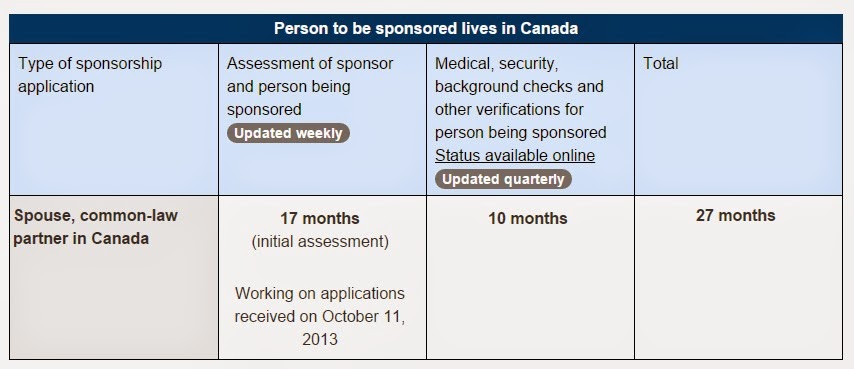
Due to the increase in processing times, protest are taking place all over Canada. After the first protest in Ottawa, a second one was hosted in Calgary (2) (video: minute 7). Additionally, a new protest will take place in Mississauga this Friday (3) and Montreal will also have a demonstration on April 11th.
--
CIC updated their website with the most recent processing times (1) for Inland Spousal Sponsorship. Unfortunately, they added 2 more months to the wait, making it a total of 27 months for the spouse of a Canadian to get Permanent Residency.
 |
| This flyer, handed at the March 1st protest in Ottawa, was edited by hand since it already became obsolete |
When these news were announced last week, CIC attempted a change of their timetable, which confused applicants.
After a week, CIC decided to restore the old timetable, that explains current processing times in a more clear way.
Due to the increase in processing times, protest are taking place all over Canada. After the first protest in Ottawa, a second one was hosted in Calgary (2) (video: minute 7). Additionally, a new protest will take place in Mississauga this Friday (3) and Montreal will also have a demonstration on April 11th.
--
Other links that might interest you:
Inland Spousal Sponsorship: One of the categories that fell further behindInland Sponsors' demonstration in Ottawa: Our first day of shooting
Why this affects you as a Canadian
--
Follow our progress on Twitter
Sign up to our newsletter
--
Sources:
Processing times. Family Sponsorship. Citizenship and Immigration Canada. Retrieved: March 24th, 2015.
CBC News Alberta. Aired: March 21st, 2015. Retrieved: March 24th, 2014.
Twitter: Inland Sponsorship @inlandsponsor. Retrieved: March 24th, 2014.
Why this affects you as a Canadian
--
Follow our progress on Twitter
Sign up to our newsletter
--
Sources:
Processing times. Family Sponsorship. Citizenship and Immigration Canada. Retrieved: March 24th, 2015.
CBC News Alberta. Aired: March 21st, 2015. Retrieved: March 24th, 2014.
Twitter: Inland Sponsorship @inlandsponsor. Retrieved: March 24th, 2014.
2015/03/17
Federal discrimination for Quebec in the Inland Sponsorship program
As you might have read in our previous post, one of the streams that captured our attention due to the increase in processing times was Inland Sponsorship.
All the delays and errors described in that post add to an extra complication for Quebec applicants: this province must issue the non-Canadian spouse a Certificate of Selection of Quebec (CSQ), which can only be issued once Citizenship and Immigration Canada (CIC) sends the spouse a letter authorizing the issuance of this document.
The CSQ is absolutely necessary to start the second stage of the process. Until CIC doesn't receive it, the application already approved in first stage can't arrive to a Decision Made (DM) stage.
According to an Operational Bulletin (1) from CIC, this letter should be sent when it's found that the sponsor meets the Federal requirements.
However, before August, 2014, according to records kept by applicants in the Inland Sponsorship category, CIC would send the letter approving the issuance of the CSQ around two months after the Acknowledgement of Receipt (AOR) was issued. This changed during the second half of 2014: now the letter is sent after first stage approval has been achieved (17 months).
This means, for Quebec applicants, around two additional months of waiting, on top of the 25 months of estimated processing times.
From the date CIC sends a correspondence to the moment the couple receives it, around a week or week and a half has passed.
The Ministère de l’Immigration, de la Diversité et de l’Inclusion (MIDI) takes a month to issue the CSQ once all the paperwork has been filled, and then it will take another month for CIC to enter the CSQ into their system once received.
Between February 26th and 27th of 2015, CIC sent letters to Quebec applicants requesting them to apply to Undertaking and CSQ at the MIDI.
So far, 20 applicants have reported receiving this letter and applying as indicated in the instructions. After sending the application, these people received a letter on March 13th, indicating that the previous letter was a mistake, and that they should not send an application to the MIDI.
Couples reported calling to the CIC call centre and receiving contradictory information. As all correspondence from CIC is signed with initials (see image above), applicants have no knowledge of who is processing their applications, so they can't ask the officer in charge about these changes.
So far, Citizenship and Immigration Canada has not given an official statement about the reasons behind this error, other than what was stated in the letter sent to applicants: "an automated mailing system (...) mistakenly issued you this correspondence."
As you might know from our previous post, CIC launched a 1-year pilot program on December 2014 to grant Open Work Permits to sponsored spouses upon Acknowledgement of Receipt (AOR), a program that has reported flaws in its implementation (see previous post for more details)
Unfortunately, even Quebec applicants who receive OWP under the pilot program are still not eligible to receive healthcare, since they also need a CSQ to be granted a Carte d'Assurance Maladie, despite the fact that they are allowed to work and must pay taxes for their income.
Follow us if you want to find answers as much as we do. Either an affected applicant, a journalist or a concerned Canadian, this journey might interest you. Feel free to fill the form to your right to receive exclusive updates and information about our project.
--
Follow our progress on Twitter
Sign up to our newsletter
--
Sources:
1. Operational bulletin 295-A: Change in Procedures for Processing Quebec Family Class Applications – Modified. Citizenship and Immigration Canada. Retrieved: March 17, 2015.
All the delays and errors described in that post add to an extra complication for Quebec applicants: this province must issue the non-Canadian spouse a Certificate of Selection of Quebec (CSQ), which can only be issued once Citizenship and Immigration Canada (CIC) sends the spouse a letter authorizing the issuance of this document.
The CSQ is absolutely necessary to start the second stage of the process. Until CIC doesn't receive it, the application already approved in first stage can't arrive to a Decision Made (DM) stage.
According to an Operational Bulletin (1) from CIC, this letter should be sent when it's found that the sponsor meets the Federal requirements.
However, before August, 2014, according to records kept by applicants in the Inland Sponsorship category, CIC would send the letter approving the issuance of the CSQ around two months after the Acknowledgement of Receipt (AOR) was issued. This changed during the second half of 2014: now the letter is sent after first stage approval has been achieved (17 months).
Extra two months for Quebec applicants
This means, for Quebec applicants, around two additional months of waiting, on top of the 25 months of estimated processing times.
From the date CIC sends a correspondence to the moment the couple receives it, around a week or week and a half has passed.
The Ministère de l’Immigration, de la Diversité et de l’Inclusion (MIDI) takes a month to issue the CSQ once all the paperwork has been filled, and then it will take another month for CIC to enter the CSQ into their system once received.
CIC mistakenly sent letters
Between February 26th and 27th of 2015, CIC sent letters to Quebec applicants requesting them to apply to Undertaking and CSQ at the MIDI.
 |
| Template letter sent to applicants on February 26th/27th, 2015 |
So far, 20 applicants have reported receiving this letter and applying as indicated in the instructions. After sending the application, these people received a letter on March 13th, indicating that the previous letter was a mistake, and that they should not send an application to the MIDI.
 |
| Template letter sent to applicants on March 13th, 2015 |
Couples reported calling to the CIC call centre and receiving contradictory information. As all correspondence from CIC is signed with initials (see image above), applicants have no knowledge of who is processing their applications, so they can't ask the officer in charge about these changes.
So far, Citizenship and Immigration Canada has not given an official statement about the reasons behind this error, other than what was stated in the letter sent to applicants: "an automated mailing system (...) mistakenly issued you this correspondence."
No healthcare for 17 months
As you might know from our previous post, CIC launched a 1-year pilot program on December 2014 to grant Open Work Permits to sponsored spouses upon Acknowledgement of Receipt (AOR), a program that has reported flaws in its implementation (see previous post for more details)
Unfortunately, even Quebec applicants who receive OWP under the pilot program are still not eligible to receive healthcare, since they also need a CSQ to be granted a Carte d'Assurance Maladie, despite the fact that they are allowed to work and must pay taxes for their income.
Follow us if you want to find answers as much as we do. Either an affected applicant, a journalist or a concerned Canadian, this journey might interest you. Feel free to fill the form to your right to receive exclusive updates and information about our project.
--
Why this affects you as a Canadian
Other links that might interest you:
Inland Spousal Sponsorship: One of the categories that fell further behindInland Sponsors' demonstration in Ottawa: Our first day of shootingWhy this affects you as a Canadian
--
Follow our progress on Twitter
Sign up to our newsletter
--
Sources:
1. Operational bulletin 295-A: Change in Procedures for Processing Quebec Family Class Applications – Modified. Citizenship and Immigration Canada. Retrieved: March 17, 2015.
2015/03/02
Our first day of shooting: Inland Sponsors' demonstration in Ottawa
Yesterday was our first day of shooting. We went to the CIC headquarter in Ottawa, where around 40 applicants of the Inland Spousal Sponsorship category gathered to raise their concerns about the increasing processing times in this category and the lack of information around it.

From 11:30 till 2 pm, they handed flyers to passersby and let them know about their situation, which remained unknown for most Canadians not involved in the process until the most recent media coverage about it shed some light.

MP for Pierrefonds- Dollard, Lysane Blanchette- Lamothe, Critic of Citizenship and Immigration Canada, and MP for Ottawa Centre, Paul Dewar, Critic for Foreign Affairs, joined the demonstration and heard some of the questions and concern this group has.

We had the opportunity to talk to some of the affected Canadian families and will release a preview very soon.

In the meantime, you can follow our progress on our Twitter account, @thebacklogdoc, or sign up to our newsletter to have exclusive behind the scenes access to our production.

Feel free to use these pictures for any coverage about the protest held yesterday under a Creative Commons license, remember to credit the production team of the documentary The Backlog and link back to this blog. If you are a member of the press, you can request pictures in high resolution without the legend here. Thank you very much.

--
Follow our progress on Twitter and Facebook
Sign up to our newsletter
MP for Pierrefonds- Dollard, Lysane Blanchette- Lamothe, Critic of Citizenship and Immigration Canada, and MP for Ottawa Centre, Paul Dewar, Critic for Foreign Affairs, joined the demonstration and heard some of the questions and concern this group has.
We had the opportunity to talk to some of the affected Canadian families and will release a preview very soon.
In the meantime, you can follow our progress on our Twitter account, @thebacklogdoc, or sign up to our newsletter to have exclusive behind the scenes access to our production.
Feel free to use these pictures for any coverage about the protest held yesterday under a Creative Commons license, remember to credit the production team of the documentary The Backlog and link back to this blog. If you are a member of the press, you can request pictures in high resolution without the legend here. Thank you very much.
--
Follow our progress on Twitter and Facebook
Sign up to our newsletter
2015/02/23
Why this affects you as a Canadian
.png)
Historically, we have heard that Canada opens their doors to immigration to compensate for low birth rates and lack of workers for certain sectors of the economy, as said by many entrepreneurs and recruiters.
However, the advantages of immigration in Canada go beyond that (1). It's not only about jobs, taxes and young labor that can compensate for the thousands of workers that retire every year. It's also cultural richness, tourism, gastronomy, diversity and much more.
Numbers and facts support Canada's need for immigration, which is ultimately beneficial to achieve the country's goals as long as it is made in an efficient and timely manner:
Economy and retirement
The biggest source of population growth (2) for many of the main Canadian cities is immigration, according to Statistics Canada. These cities that grew thanks to immigration also reported the highest economic growth (3) in the country.
Why is this important? Not only for economic growth itself, but also because the balance between people retiring and people entering the job market is what makes the retirement system sustainable.
As pillar 1 of the Canadian Retirement System (4) is the Old Age Security (OAS) Program, funded with Canadian taxes, it is fundamental to keep the balance mentioned above to guarantee a constant tax stream to this program.
Added to the low birth rates (10 births per 1000 people by 2013) (5), thousands of Canadians migrate every year to settle in countries such as the United States, United Kingdom, China, Australia, Japan and New Zealand. This makes the above mentioned balance more difficult to keep.
By 2010, 2.8 million Canadian Citizens lived abroad (6), which is equivalent to 9% of the Canadian population currently in the country.
Unfortunately, the gaps and errors in the current Canadian immigration system are keeping the country from bringing the best of immigration and from solving the problems the country is facing.
Immigration gaps
These are some consequences of the delays and errors in Citizenship and Immigration Canada:
- Permanent Residency under the Federal Skilled program and the Canadian Experience Class, both valid until the end of 2014, took up to 3 years to be granted (7), depending on the country of origin of the immigrant. This means that Permanent Residents who just enter the country were admitted based on the needs of the labour market 3 years ago.
- Canadians who choose to marry a non-Canadian must wait more than two years for their spouse to be granted Permanent Residency. (8) This not only influences the freedom of a Canadian to choose who to marry, but has other implications to the economy and wellbeing of them and the country:
If their spouse lives abroad, this means more than two years apart, depending on the country of origin of the foreign spouse. In the meantime, Canadian spouses will continue to support their spouse abroad, and probably her family. This money, instead of being spent in Canadian businesses, is spent on business abroad, since the spouse does not live in the country yet.
If their spouse lives in Canada, this means more than two years without healthcare, education, possibility to work, travel abroad and be part of the Canadian society. The inability of this spouse to work and study leads to a slower integration into the society and labor market, while the inability to access healthcare means that the household might postpone or cancel altogether their plans to have kids. Due to low birth rates in the country, provinces such as Quebec help in-vitro fertilization with public funding (9). Part of this balance needed in birth rates could be achieved by allowing these couples access to healthcare, which would encourage them to start their families.
This situation also means less tax contributions per family: the Canadian spouse gets tax reductions for economically supporting the non-Canadian spouse (10), plus, they also receive credits for all the medical expenses paid (11), since this spouse doesn't have healthcare. Added to this situation, the spouse can't contribute to taxes until allowed to work.
- Qualified people around the world see CIC's errors and delays (12) as a deterrent to apply for the Canadian Permanent Residency. Many prefer to choose countries such as Australia, where processing times are significantly lower while fees are almost the same.
Also, Australia is getting better results in their economy (13) as a result of a more efficient and timely immigration process. In the cited report, Australia also recognizes that the need for skilled migrants is increasingly not an exclusive problem of Australia and Canada: low birth rates and aging population is a phenomena that other countries are suffering, which will lead them to adopt policies to attract qualified migrants. This will intensify the competition between countries to attract the best immigrants: only those with better systems will succeed.
- Canadian companies who lack specialized staff often can't fulfill their needs in a timely manner because processing times for Permanent Residency are too long. The Canadian Government offered the Express Entry (14) program as a solution, but the processing times of 6 months were deemed too long (15) by the entrepreneurs, who need staff immediately.
- Foreign students and workers have higher possibilities of integration to the Canadian society than immigrants who have never visited Canada. Also, the fact that they are already in the labour market proves that their skills are needed. However, the new points system of the current Permanent Residency program, Express Entry (14), practically excludes them. Companies who want these workers to become Permanent Residents so that they can retain their talent in a Canadian company, must go through an additional hardship: the request for a Labour Market Impact Assessment, which costs $1,100 (16) for each worker. Although there is a commitment to expedite LMIA for certain types of jobs and grant it in 10 days, the reality is that in most cases it can take months (17) while Human Resources and Development Services Canada finishes all verifications in the company that requested it.
All of these reasons have an impact in the Canadian economy, which impacts YOU directly.
Citizenship and Immigration Canada operates on your taxes and on the processing fees applicants pay every time they submit an application.
Do you want to know how well your taxes are being invested for your benefit? Follow our journey and help us find these and more answers to the immigration questions.
--
Follow us on Twitter
Sign in to our Newsletter
--
Sources:
1. "Why Canada needs a flood of immigrants" The Globe and Mail. May. 04 2012. Retrieved: February 17, 2015.
2. "Immigration main source of population growth in cities: Statistics Canada" Montreal Gazette. February 11, 2015. Retrieved: February 17, 2015.
3. "Prairie cities to lead Canadian economic growth over next two years" Calgary Herald. September 19, 2014. Retrieved: February 17, 2015.
4. Report: "Intergenerational Balance of the Canadian Retirement Income System" Chief Actuary Jean-Claude Ménard and Actuary Assia Billig, Office of the Superintendent of Financial Institutions, Canada. Retrieved: February 17, 2015.
5. The World Factbook. Central Intelligence Agency of the United States. Retrieved: February 24, 2015.
6. Canadians Abroad. Asia Pacific Foundation of Canada. 2011. Retrieved: February 24, 2015.
7. Processing times for federal skilled worker applications. Citizenship and Immigration Canada. Retrieved: February 17, 2015.
8. Processing Times: Family Sponsorship. Citizenship and Immigration Canada. Retrieved: February 17, 2015.
9. Québec Assisted Reproduction Program. Portail santé mieux-être from the Quebec Ministry of Health. Retrieved: February 17, 2015.
10. Tax Return guide: Line 303 - Spouse or common-law partner amount. Canada Revenue Agency. Retrieved: February 17, 2015.
11. Tax Return guide: Line 330 - Medical expenses for self, spouse or common-law partner, and your dependent children born in 1997 or later. Canada Revenue Agency. Retrieved: February 17, 2015.
12. ‘High error rate’ found in Canada’s immigration processing. Toronto Star. January 05, 2015. Retrieved on February 19, 2015.
13. Report: "A Comparison of Australian andCanadian Immigration Policiesand Labour Market Outcomes" The National Institute of Labour Studies, Flinders University. September 2004.
14. Express Entry guide. Citizenship and Immigration Canada. Retrieved: February 17, 2015.
15. "Is ‘express entry’ the solution to Canada’s immigration issues?" Canadian Lawyer Magazine. September 22, 2014. Retrieved: February 17, 2015.
16. Labour Market Impact Assessment (LMIA) guide. FW Canada. Retrieved: February 17, 2015.
17. LMIA Processing Time & Changes to the Temporary Foreign Worker Program. Visa Place. Retrieved: February 19, 2015.
2015/02/16
How this project was born

Our team first came in contact with a group of Canadians sponsoring their non-Canadian spouses to become Permanent Residents under the Inland Spousal Sponsorship program. They told us their stories and how they felt their Government wasn't giving them the answers they deserved.
Many of them support their families on a single income, their spouses don't have access to healthcare or education, and the family can't travel abroad because they risk losing their entire application.
We also came in contact with some of the affected applicants for Permanent Residency that saw their applications transferred and then forgotten for years after the Canadian Consulate in Buffalo was closed.
They were deemed "the forgotten of Buffalo", and they faced unprecedentedly long processing times for their PR applications while in Canada, many of them not allowed to work in the meantime.
After creating social media outlets for this documentary, we started receiving more and more testimonials about how the Canadian Immigration system was not fulfilling the needs of both Canadians and foreigners.
 |
| flag flap / Spatial Mongrel / CC BY |
Among them, we were contacted by many applicants of the Canadian Experience Class. This program was aimed at attracting international students and workers with higher chances of integration in the Canadian society to stay as Permanent Residents. However, these potential residents were forgotten by the Canadian Government when the new Express Entry system came into place.
Other testimonials we received include applicants to Canadian Citizenship that have seen their applications delayed for up to six years, allegedly without apparent reason.
After learning about all these cases, we decided to seek for answers. Why are processing times increasing for some categories and what is Citizenship and Immigration Canada (CIC) doing to improve this? Why are Canadian immigration programs constantly changing and applying these changes retroactively? How do all these problems in Canadian immigration affect the country and the economy?
Follow us if you want to find answers as much as we do. Either an affected applicant, a journalist or just a concerned Canadian, this journey might interest you. Feel free to fill the form to your right to receive exclusive updates and information about our project.
--
Follow our progress on Twitter
Sign up to our newsletter
Subscribe to:
Posts (Atom)